The short version of this printable ring sizer chart: every ring size system measures one thing, the inside of the ring. Get the inside diameter (or the finger circumference, which is the same number times π) and you have your size in every country. Print the sheet below at actual size, lay a ring that fits on the circles or wrap the paper strip around your finger, then read the result in the table.
For everything else, the free conversion calculator covers 20 categories, ring sizes included.
A ring is the one purchase where a few tenths of a millimetre decide everything. Half a US size is 0.41 mm of diameter, less than half a millimetre, and it is the difference between a ring that spins and a ring that will not pass the knuckle. Jewellers measure with steel gauges. At home you need two things: a sizer you can trust, and a ring size chart that turns that measurement into the size printed on the shop’s website.
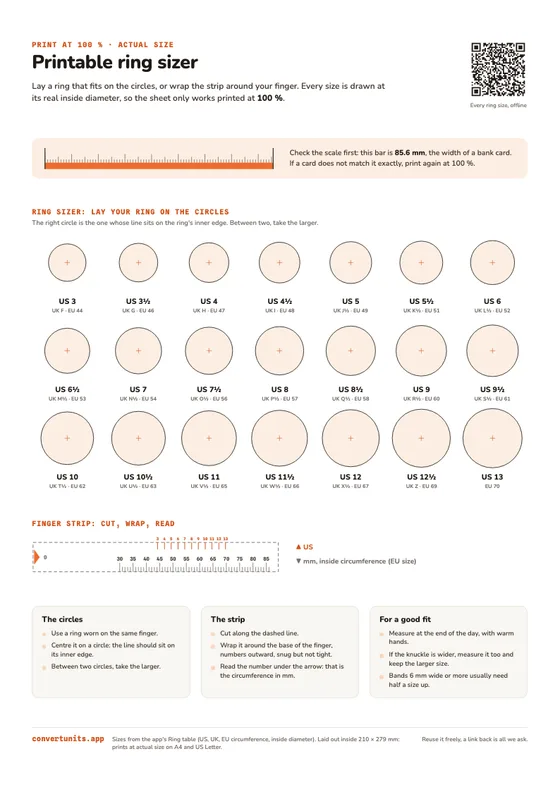
Free printable
The ring sizer, on one A4 or Letter sheet
21 circles from US 3 to US 13 drawn at their real inside diameter, a strip to wrap around your finger, and a bar the width of a bank card to check the scale.
Download the PDFOr carry every figure in your pocket:
How to use a printable ring sizer chart
A printer will quietly shrink a page if you let it. Between A4 and Letter, “Fit to page” scales a sheet to 94 or 97 %, and on a US 7 ring that is 0.5 to 1 mm off the diameter: between half a size and more than a full size. So a printable ring sizer chart is only as good as its last step, the scale check.
- Print at 100 %. In the print dialog choose “Actual size” (Acrobat) or Scale 100 % (Preview, Chrome), never “Fit”. The sheet sits inside the 210 × 279 mm area that A4 and US Letter share, so neither paper clips it. Our A4 vs Letter guide explains why that matters.
- Check the bar. It is exactly 85.6 mm long, the width of any bank or ID card (the ISO/IEC 7810 ID-1 format). Lay a card on it. If the ends do not line up, print again.
- Use the circles if you have a ring that fits. Centre it on a circle. The right one is the circle whose line sits on the ring’s inner edge. Between two circles, take the larger.
- Use the strip if you do not. Cut it out, wrap it around the base of the finger with the numbers outward, and read the number under the arrow. That number is your finger circumference in mm, which is your EU size; the marks along the top give the US size.
Find your ring size at home: three methods, ranked
There are three ways to find your ring size at home, and they are not equally reliable.
An existing ring on the circles is the most accurate way to find your ring size at home, because a ring does not stretch and you are measuring exactly what the jeweller measures: the inside diameter. Use a ring worn on the same finger of the same hand. Hands are rarely symmetrical, and the dominant one is often a little larger.
The paper strip comes next. Paper barely stretches, so the reading is honest, as long as you wrap it snugly without pulling. Read it twice, a few hours apart.
A piece of string is the method everyone suggests and the least reliable. String stretches, slips and compresses, and a 2 mm error in circumference is close to a whole US size. If string is all you have, mark it with a pen, lay it flat on a ruler and treat the result as a first estimate.
Whatever the method, a few rules hold:
- Measure at the end of the day, with warm hands. Fingers are smaller in the cold and in the morning.
- Mind the knuckle. The ring has to slide over it. If your knuckle is noticeably wider than the base of the finger, measure both and keep the larger size.
- Wide bands need room. Jewellers usually advise half a size up for bands 6 mm wide or more, because more of the finger is covered.
Ring size chart: US, UK, EU and Japan side by side
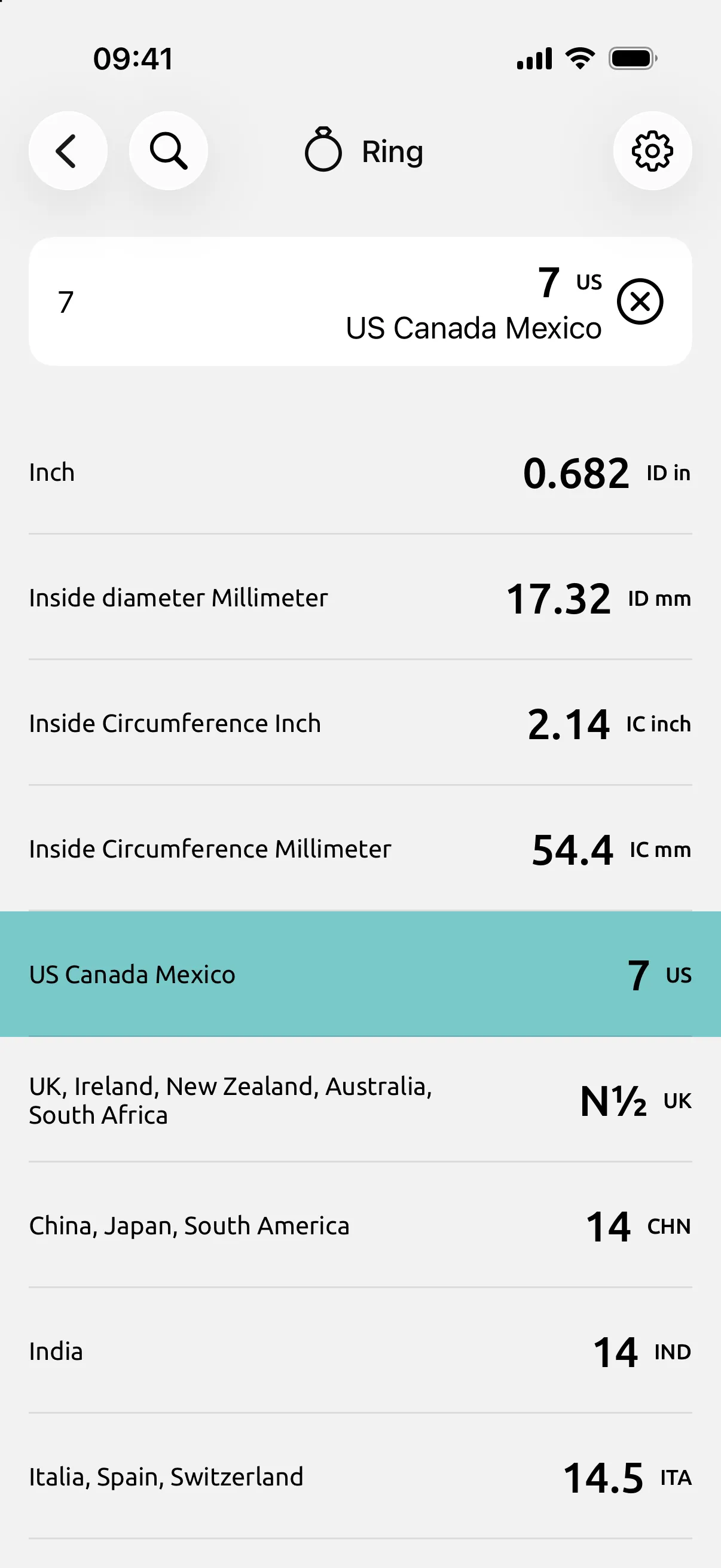
This ring size chart comes from the same table as the app’s Ring screen. The highlighted row is US 7, the size shown in the app screenshot further down. Every system on the line describes the same ring.
| US & Canada | UK & Australia | Inside diameter (mm) | Inside diameter (in) | Inside circumference (mm, EU) | Italy, Spain, Switzerland | Japan, China |
|---|---|---|---|---|---|---|
| 4 | H | 14.88 | 0.586 | 46.8 | 6.75 | 7 |
| 4½ | I | 15.29 | 0.602 | 48 | 8 | 8 |
| 5 | J½ | 15.7 | 0.618 | 49.3 | 9.25 | 9 |
| 5½ | K½ | 16.1 | 0.634 | 50.6 | 10.5 | 10 |
| 6 | L½ | 16.51 | 0.65 | 51.9 | 11.75 | 11 |
| 6½ | M½ | 16.92 | 0.666 | 53.1 | 13.25 | 13 |
| 7 | N½ | 17.32 | 0.682 | 54.4 | 14.5 | 14 |
| 7½ | O½ | 17.73 | 0.698 | 55.7 | 15.75 | 15 |
| 8 | P½ | 18.14 | 0.714 | 57 | 17 | 16 |
| 8½ | Q½ | 18.54 | 0.73 | 58.3 | 18.25 | 17 |
| 9 | R½ | 18.95 | 0.746 | 59.5 | 19.5 | 18 |
| 9½ | S½ | 19.35 | 0.762 | 60.8 | 20.75 | 19 |
| 10 | T½ | 19.76 | 0.778 | 62.1 | 22 | 20 |
| 10½ | U½ | 20.17 | 0.794 | 63.4 | 23.25 | 22 |
| 11 | V½ | 20.57 | 0.81 | 64.6 | 24.75 | 23 |
| 11½ | W½ | 20.98 | 0.826 | 65.9 | 26 | 24 |
| 12 | X½ | 21.39 | 0.842 | 67.2 | 27.25 | 25 |
Feel free to reuse this ring size chart or the PDF on your own site; a link back to this page is all we ask.
How each country counts ring sizes
Behind the columns of any ring size chart, there are only two real measurements and a handful of ways to label them.
- EU sizes are the circumference. The international standard, ISO 8653, defines ring size as the inside circumference in millimetres. A size 54 ring is 54 mm around the inside. France, Belgium, Austria and the Nordic countries use it as is.
- US ring sizes are a linear scale on the diameter. Size 0 is 11.63 mm across, and each whole size adds 0.8128 mm (0.032 in) of diameter, about 2.55 mm of circumference. Canada and Mexico use the same numbers, in quarter and half steps.
- UK letter sizes (also Ireland, Australia, New Zealand) run from A to Z with half letters. British Standard BS 6820 sets one letter at 1.25 mm of circumference, which is why a whole US size covers about two letters.
- Italy, Spain and Switzerland take the circumference and subtract 40: 54.4 mm becomes 14.5.
- Germany uses both: “Ringgröße 54” is the circumference, “17” or “17.3” is the inside diameter. Same ring, two numbers.
- Japan and China use their own numbered scale, with no simple formula behind it. Read them off the table.
Buying a ring as a surprise
Often the finger you need to measure is not your own. If the ring is a gift, borrow one the person already wears on the same finger, ideally for an evening. Print out ring size circles at 100 %, put the ring on them, note the closest circle, and give the ring back before anyone notices. No ring to borrow? Trace the inside of one onto paper with a sharp pencil, measure the diameter across the middle, and read the size from the inside diameter column above.
If you are torn between two sizes, go up: a slightly loose ring can still be worn while you have it adjusted. Keep in mind that some designs, such as eternity bands set all the way round, can barely be resized at all.
Why two ring size charts never quite agree
Compare the ring size chart of a few jewellers and the same US size can land on slightly different EU numbers. Nobody is wrong. Some round the circumference, some round the diameter first, and some publish sizes for comfort-fit bands, which are domed inside and sit a touch looser. The differences stay within a quarter size, which is why the rule above (between two sizes, take the larger) does more for you than any extra decimal.
A German jeweller tells you a ring is size 17. What is the 17?
In Germany a two-digit number in the 50s or 60s is the circumference, and a number around 15 to 22 is the inside diameter. A 17 mm ring is about a US 6½.
The app answers this kind of question in one tap.
Faster than any printable ring sizer chart
The printable ring sizer chart gets you one measurement. The rest is a lookup, and that is what Conversion Calculator is for. Its Ring screen takes a diameter or circumference in mm or inches, or a US, UK, Italian, Japanese or Indian size, and shows every other system on the same screen, offline. It sits next to shoe and clothing sizes among the everyday conversions the app was built around.
Get the app free, and keep the printable ring sizer for the next gift. For other conversions between inches and millimetres, the inches to cm chart is the next page to bookmark.