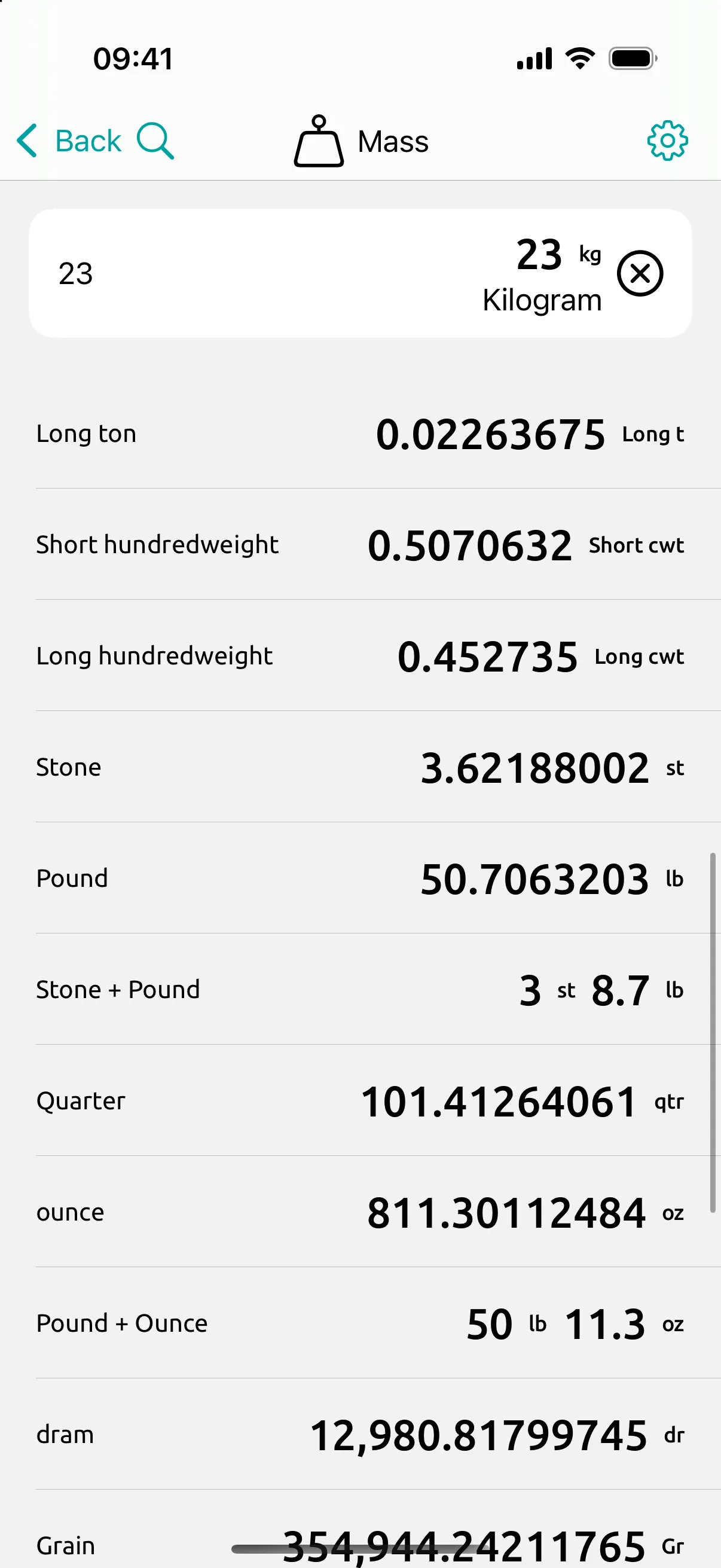
Quick answer: 23 kg is 50.7 lbs. But careful with the reverse: a 50 lb allowance is only 22.7 kg, not 23. That 50 lb standard is written into US carriers’ rules (American Airlines’ checked bag policy, for instance).
That 300-gram gap sounds like nothing. On an airport scale, it is the difference between walking through and repacking your bag in front of the queue, or paying an overweight fee that often costs more than the ticket sale you hunted for.
The baggage conversion chart
| Allowance | In the other unit | Where you meet it |
|---|---|---|
| 7 kg | 15.4 lbs | Cabin bag, many Asian and low-cost carriers |
| 10 kg | 22 lbs | Cabin bag, European low-cost |
| 23 kg | 50.7 lbs | Checked bag, international economy standard |
| 50 lbs | 22.7 kg | Checked bag, US domestic standard |
| 32 kg | 70.5 lbs | Checked bag, business and first |
| 70 lbs | 31.8 kg | US premium allowance |
Why the trap exists
Airlines write rules in their home unit. A transatlantic itinerary can involve a European leg filed in kilograms and a US domestic leg filed in pounds. Your bag did not change, the limit did. Packing to exactly 23.0 kg is fine for the 23 kg leg and 300 g overweight for the 50 lb one.
The rule of thumb: 1 kg is about 2.2 lbs. For a quick check in your head, double the kilograms and add 10 percent.
Weighing without a luggage scale
Bathroom scale method: weigh yourself holding the bag, then without it, subtract. Cheap scales drift, so keep a 500 g margin under the limit. If the hotel has no scale at all, the app converts what the tag or the airline site says in one tap, offline included, which is exactly the airport situation it was designed for.
Your US carrier allows 50 lbs. Your bag weighs 23.0 kg. Are you fine?
50 lbs = 22.68 kg. A bag packed to exactly 23 kg is about 300 g over a 50 lb allowance.
The app answers this kind of question in one tap.
One tap at the check-in desk
Type 23 into Conversion Calculator and read pounds, kilograms, even stones at once, with no signal in the terminal. Packing is one of the everyday scenes the app covers, and once you land, the oven in your rental kitchen speaks Fahrenheit too. For the bag that goes in the overhead locker, the cabin bag sizes by airline chart has every limit in cm and inches, and what the gate charges. For the one that goes in the hold, the checked bag allowance of 34 airlines has the weight, the size and what one kilo over costs.
Get the app free before your next check-in.