Quick answer: the free under-seat bag on European low-cost airlines is 40 × 30 × 20 cm (15.7 × 11.8 × 7.9 in). The standard cabin bag is 55 × 40 × 23 cm (21.7 × 15.7 × 9.1 in) and 8 to 10 kg. In North America it is 22 × 14 × 9 in (56 × 36 × 23 cm), usually with no weight limit. The place where it costs money is the gate, and the fee runs from about 46 to 110 euros depending on the airline.
Find your airline 34
European network airlines
North America
Airlines publish their limits in their home unit, the sizer at the gate does not convert anything, and a bag sold as “carry-on approved” was approved for one airline, not yours. This page has every limit in both units, read on the airlines’ own pages, with the date each line was checked. Below the chart is the part nobody prints on the label: how a soft bag really behaves in a sizer.
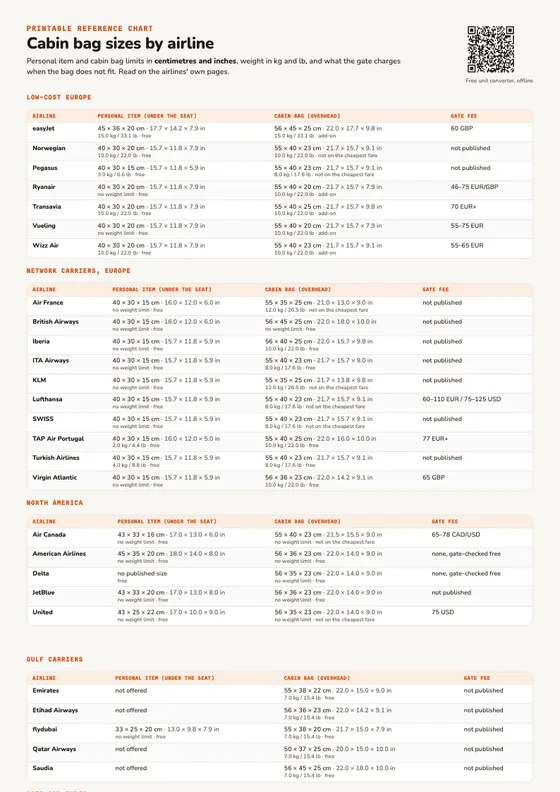
Free printable
Every airline on one page
Personal item and cabin bag limits in cm and inches, weight in kg and lb, gate fees, and the three rules for soft bags. Two A4 sheets for the drawer where the passports live.
Download the PDFOr carry every figure in your pocket:
Low-cost Europe
The pattern is the same everywhere: one small bag under the seat is free, the bag in the overhead locker is a paid option, and the gate is where the two are told apart.
| Airline | Personal item (under the seat) | Cabin bag (overhead) | Weight | Gate fee | Source |
|---|---|---|---|---|---|
| easyJet | 45 × 36 × 20 cm 17.7 × 14.2 × 7.9 in 15 kg / 33.1 lb incl. wheels and handles | 56 × 45 × 25 cm 22 × 17.7 × 9.8 in paid add-on: Large cabin bag (or Plus, FLEXI, Up front, Extra legroom) | 15 kg / 33.1 lb | 60 GBP | official page |
| Norwegian | 40 × 30 × 20 cm 15.7 × 11.8 × 7.9 in 10 kg / 22 lb | 55 × 40 × 23 cm 21.7 × 15.7 × 9.1 in included except on the cheapest fare | 10 kg / 22 lb | not published | official page |
| Pegasus | 40 × 30 × 15 cm 15.7 × 11.8 × 5.9 in 3 kg / 6.6 lb | 55 × 40 × 23 cm 21.7 × 15.7 × 9.1 in included except on the cheapest fare | 8 kg / 17.6 lb | not published | official page |
| Ryanair | 40 × 30 × 20 cm 15.7 × 11.8 × 7.9 in | 55 × 40 × 20 cm 21.7 × 15.7 × 7.9 in paid add-on: Priority & 2 Cabin Bags | 10 kg / 22 lb | 46–75 EUR/GBP | official page |
| Transavia | 40 × 30 × 20 cm 15.7 × 11.8 × 7.9 in 10 kg / 22 lb | 55 × 40 × 25 cm 21.7 × 15.7 × 9.8 in paid add-on: Cabin bag | 10 kg / 22 lb | 70 EUR+ | official page |
| Vueling | 40 × 30 × 20 cm 15.7 × 11.8 × 7.9 in | 55 × 40 × 20 cm 21.7 × 15.7 × 7.9 in paid add-on: Fly or Fly Grande bundle | 10 kg / 22 lb | 55–75 EUR | official page |
| Wizz Air | 40 × 30 × 20 cm 15.7 × 11.8 × 7.9 in 10 kg / 22 lb | 55 × 40 × 23 cm 21.7 × 15.7 × 9.1 in paid add-on: WIZZ Priority | 10 kg / 22 lb | 55–65 EUR | official page |
Figures read on the airlines’ own pages, last check September 2026.
Network carriers, Europe
The traditional carriers include the overhead bag in most fares, with a weight limit that the low-cost airlines do not always have, and the same limit for everyone: 8 kg is a full backpack with a laptop, not a weekend.
| Airline | Personal item (under the seat) | Cabin bag (overhead) | Weight | Gate fee | Source |
|---|---|---|---|---|---|
| Air France | 40 × 30 × 15 cm 16 × 12 × 6 in | 55 × 35 × 25 cm 21 × 13 × 9 in included except on the cheapest fare | 12 kg / 26.5 lb | not published | official page |
| British Airways | 40 × 30 × 15 cm 16 × 12 × 6 in | 56 × 45 × 25 cm 22 × 18 × 10 in free on every fare | no published limit | not published | official page |
| Iberia | 40 × 30 × 15 cm 15.7 × 11.8 × 5.9 in | 56 × 40 × 25 cm 22 × 15.7 × 9.8 in free on every fare | 10 kg / 22 lb | not published | official page |
| ITA Airways | 40 × 30 × 15 cm 15.7 × 11.8 × 5.9 in | 55 × 40 × 23 cm 21.7 × 15.7 × 9 in free on every fare | 8 kg / 17.6 lb | not published | official page |
| KLM | 40 × 30 × 15 cm 15.7 × 11.8 × 5.9 in | 55 × 35 × 25 cm 21.7 × 13.8 × 9.8 in included except on the cheapest fare | 12 kg / 26.5 lb | not published | official page |
| Lufthansa | 40 × 30 × 15 cm 15.7 × 11.8 × 5.9 in | 55 × 40 × 23 cm 21.7 × 15.7 × 9.1 in included except on the cheapest fare | 8 kg / 17.6 lb | 60–110 EUR / 75–125 USD card only | official page |
| SWISS | 40 × 30 × 15 cm 15.7 × 11.8 × 5.9 in | 55 × 40 × 23 cm 21.7 × 15.7 × 9.1 in included except on the cheapest fare | 8 kg / 17.6 lb | not published | official page |
| TAP Air Portugal | 40 × 30 × 15 cm 16 × 12 × 5 in 2 kg / 4.4 lb | 55 × 40 × 25 cm 22 × 16 × 10 in free on every fare | 10 kg / 22 lb | 77 EUR+ | official page |
| Turkish Airlines | 40 × 30 × 15 cm 15.7 × 11.8 × 5.9 in 4 kg / 8.8 lb | 55 × 40 × 23 cm 21.7 × 15.7 × 9.1 in free on every fare | 8 kg / 17.6 lb | not published | official page |
| Virgin Atlantic | 40 × 30 × 15 cm 15.7 × 11.8 × 5.9 in | 56 × 36 × 23 cm 22 × 14.2 × 9.1 in free on every fare | 10 kg / 22 lb | 65 GBP | official page |
Figures read on the airlines’ own pages, last check September 2026.
North America
US and Canadian carriers count in inches and rarely publish a cabin weight. The gap is on the cheapest fares, where the overhead bag is no longer included on several airlines.
| Airline | Personal item (under the seat) | Cabin bag (overhead) | Weight | Gate fee | Source |
|---|---|---|---|---|---|
| Air Canada | 43 × 33 × 16 cm 17 × 13 × 6 in | 55 × 40 × 23 cm 21.5 × 15.5 × 9 in included except on the cheapest fare | no published limit | 65–78 CAD/USD | official page |
| American Airlines | 45 × 35 × 20 cm 18 × 14 × 8 in | 56 × 36 × 23 cm 22 × 14 × 9 in free on every fare | no published limit | none, gate-checked free | official page |
| Delta | no published size | 56 × 35 × 23 cm 22 × 14 × 9 in free on every fare | no published limit | none, gate-checked free | official page |
| JetBlue | 43 × 33 × 20 cm 17 × 13 × 8 in | 56 × 36 × 23 cm 22 × 14 × 9 in free on every fare | no published limit | not published | official page |
| United | 43 × 25 × 22 cm 17 × 10 × 9 in | 56 × 35 × 23 cm 22 × 14 × 9 in included except on the cheapest fare | no published limit | 75 USD | official page |
Figures read on the airlines’ own pages, last check September 2026.
Gulf carriers
Seven kilos is the number from Dubai to Riyadh, and on most of these airlines it covers everything you carry: Emirates, Qatar Airways, Etihad and Saudia publish one cabin bag in economy and no separate personal item, so the laptop bag goes inside it. flydubai is the exception with a 33 × 25 × 20 cm personal item, still inside the same 7 kg. The sizes are not the European standard either: Qatar Airways stops at 50 cm long, Saudia allows 45 cm of width.
| Airline | Personal item (under the seat) | Cabin bag (overhead) | Weight | Gate fee | Source |
|---|---|---|---|---|---|
| Emirates | not offered | 55 × 38 × 22 cm 22 × 15 × 9 in free on every fare | 7 kg / 15.4 lb | not published | official page |
| Etihad Airways | not offered | 56 × 36 × 23 cm 22 × 14.2 × 9.1 in free on every fare | 7 kg / 15.4 lb | not published | official page |
| flydubai | 33 × 25 × 20 cm 13 × 9.8 × 7.9 in | 55 × 38 × 20 cm 21.7 × 15 × 7.9 in free on every fare | 7 kg / 15.4 lb | not published | official page |
| Qatar Airways | not offered | 50 × 37 × 25 cm 20 × 15 × 10 in free on every fare | 7 kg / 15.4 lb | not published | official page |
| Saudia | not offered | 56 × 45 × 25 cm 22 × 18 × 10 in free on every fare | 7 kg / 15.4 lb | not published | official page |
Figures read on the airlines’ own pages, last check September 2026.
Asia and India
Japan is the generous one. JAL and ANA give you 10 kg for the cabin bag and the personal item together, on a 55 × 40 × 25 cm bag. India goes the other way: one bag of 7 kg, because airport security applies the one hand baggage rule to every carrier, and on Air India Express the laptop counts inside that 7 kg. AirAsia works the same way, 7 kg for the two bags together. Singapore Airlines publishes no length by width by height at all, only the sum of the three sides, 115 cm.
| Airline | Personal item (under the seat) | Cabin bag (overhead) | Weight | Gate fee | Source |
|---|---|---|---|---|---|
| Air India | no published size | 55 × 40 × 20 cm 21 × 15 × 7 in free on every fare | 7 kg / 15.4 lb | not published | official page |
| Air India Express | not offered | 56 × 36 × 23 cm 22 × 14.2 × 9.1 in free on every fare | 7 kg / 15.4 lb | not published | official page |
| AirAsia | 40 × 30 × 10 cm 15.7 × 11.8 × 3.9 in | 56 × 36 × 23 cm 22 × 14.2 × 9.1 in free on every fare | 7 kg / 15.4 lb | not published | official page |
| ANA | 40 × 30 × 20 cm 15.7 × 11.8 × 7.9 in | 55 × 40 × 25 cm 21.7 × 15.7 × 9.8 in free on every fare | 10 kg / 22 lb | not published | official page |
| IndiGo | no published size | 55 × 35 × 25 cm 21.7 × 13.8 × 9.8 in free on every fare | 7 kg / 15.4 lb | not published | official page |
| Japan Airlines | no published size | 55 × 40 × 25 cm 21.7 × 15.7 × 9.8 in free on every fare | 10 kg / 22 lb | not published | official page |
| Singapore Airlines | 40 × 30 × 10 cm 15.7 × 11.8 × 3.9 in | 115 cm total (L + W + H) 45.3 in free on every fare | 7 kg / 15.4 lb | not published | official page |
Figures read on the airlines’ own pages, last check September 2026.
Feel free to reuse this chart or the PDF on your own site or in your documentation; a link back to this page is all we ask.
Will it fit? A soft bag loses depth, never height
This is the question behind most of the arguments at the gate, and the answer is geometry, not luck.
- A soft backpack squeezes in depth, not in height. The back panel and the shoulder straps fix its height, so a 46 cm bag stays 46 cm tall however little you put in it. It only loses height if the top third is empty and can fold over. Pack heavy things at the bottom, leave the top loose.
- The sizer measures the bag as packed. A rigid bag, the box-shaped kind with a frame, cannot lose anything: 43 cm on the back panel is 3 cm too tall for a 40 cm sizer, whatever the product page says. The label measures the empty bag, the sizer measures yours.
- Test at home. Cut a cardboard box to the inside dimensions of the sizer, 40 × 30 × 20 cm for most low-cost airlines, and drop the packed bag into it. If it needs a push, it will need a push at the gate too, in front of a queue. Then weigh it on the bathroom scale: yourself with the bag, yourself without, subtract.
The same logic applies to the “wheels and handles” note some airlines add. Wizz Air excludes them from the measurement but caps the wheels at 5 cm; easyJet includes them. A trolley sold at 55 × 40 × 20 cm often measures 57 cm to the top of the handle.
Where they check, and what it costs
The low-cost airlines check at the boarding gate, with a metal sizer and staff whose job is that sizer. Lufthansa says it checks at the check-in counter or at the gate, and that any bag brought to the gate counts as cabin baggage, whatever your checked allowance is.
The fee is the point. The same bag that costs 12 to 36 euros as a Priority add-on when you book costs 46 to 75 euros at a Ryanair gate, and the airline can refuse it outright on a full flight. Lufthansa charges 60 to 110 euros to send a non-compliant bag to the hold, by card only. Buy the bag online the day you notice you need it; the gate price is the airline’s way of making sure you do.
Personal item or cabin bag: which one is yours
The personal item is the bag that fits under the seat in front of you: a handbag, a laptop bag, a small backpack. On every airline in the chart it is free, though four of them now cap it at 3 to 15 kg. The cabin bag is the one that goes in the overhead locker, a small trolley or a large backpack. On low-cost fares it is an add-on; on most network fares it is included, except on the new basic fares that Lufthansa introduced in May 2026 and that several US carriers have had for years.
If you only carry one bag, make it the personal item size and skip the question entirely. A 40 × 30 × 20 cm bag holds a weekend, and no sizer in the chart is smaller than that.
When the bag does not arrive
A different problem, but the same readers ask it, so here is the short version. Report it at the airport before leaving the baggage hall, and get the WorldTracer reference, five letters and five digits; that file is the only thing that makes a bag move. Give an address where you will be for the next few days, not tonight’s hotel. Buy what you need and keep every receipt: under the Montreal Convention the airline reimburses reasonable purchases, up to roughly 1,600 euros. The airline of your last flight handles the claim, even if another one lost the bag. After 21 days the bag counts as lost and the claim changes nature. An AirTag tells you where it sits; it does not make anyone at the airport walk to it.
Fast answers
- 40 × 30 × 20 cm in inches: 15.7 × 11.8 × 7.9 in, the free bag on Ryanair and Wizz Air.
- 55 × 40 × 23 cm in inches: 21.7 × 15.7 × 9.1 in, the European cabin bag.
- 22 × 14 × 9 in in cm: 56 × 36 × 23 cm, the North American carry-on.
- 45 × 36 × 20 cm in inches: 17.7 × 14.2 × 7.9 in, the easyJet under-seat bag.
- 7 kg in lb: 15.4 lb. 8 kg: 17.6 lb. 10 kg: 22 lb. 12 kg: 26.5 lb.
- Litres to expect: a 40 × 30 × 20 cm bag holds about 20 to 24 litres packed; 55 × 40 × 23 cm holds 35 to 40 litres.
Your soft backpack is 43 cm tall and the sizer is 40 cm. You pack it two-thirds full. Does it pass?
A soft bag loses depth when it is not full, never height: the back panel and the straps set the height. It passes only if the empty top third can fold over.
The app answers this kind of question in one tap.
Read the tag in your own unit
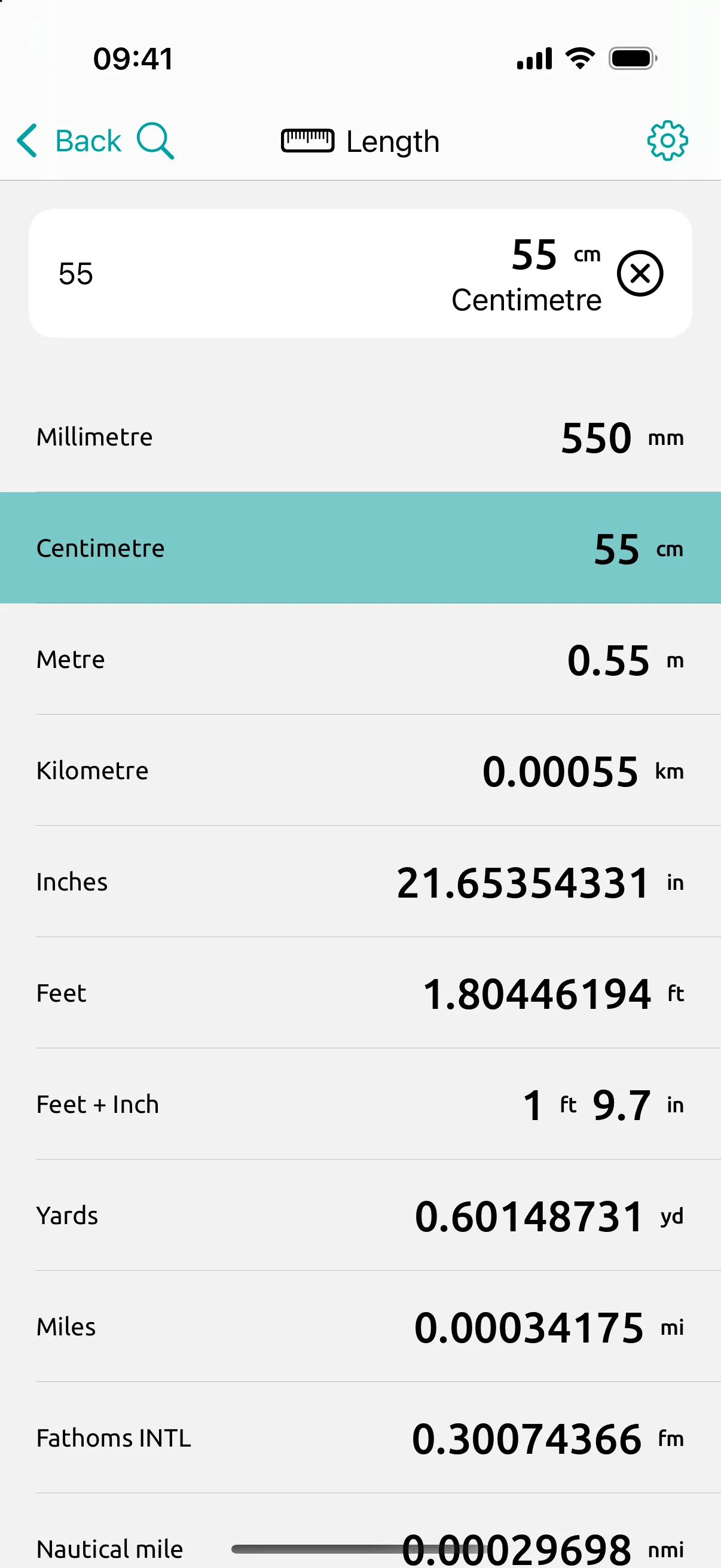
Every line in this chart is a centimetres and inches problem, or a kilograms and pounds one, and that is what the app in your pocket does. Type 55 cm into Conversion Calculator and read 21.7 in, offline, in the queue, with the calculator built into the field for the bag that is 2 cm over. Packing is one of the everyday scenes the app was built around, right next to the checked bag allowance of the same 34 airlines, the 23 kg checked bag that is really 50.7 lb and inches to centimetres.
Get the app free before you pack. And if the chart deserves a spot in the drawer with the passports, the PDF is here.