Quick answer: a 9-inch round and an 8-inch square hold the same batter, 64 square inches (415 cm²). A 20 cm tin is an 8-inch round, a 23 cm is a 9-inch, a 24 cm is a 9-inch plus 10 %. Two 9 × 13 in pans make exactly one half sheet. Same depth, same oven, same time. Only when the pan gets deeper does the oven change: 15 °C (25 °F) lower and a quarter more time.
Recipes name a pan, cupboards hold another one, and the two are written in different units on each side of the Atlantic. The mistake that ruins a cake is not the wrong pan, it is the wrong depth of batter in it: too thin dries out, too thick sinks in the middle. So the number that matters is the area of the bottom, not the volume, and that is what this chart compares. Every pan below has its size in both units, the area, the volume to the brim computed from the dimensions, and the batter it takes at two-thirds full.
Free printable
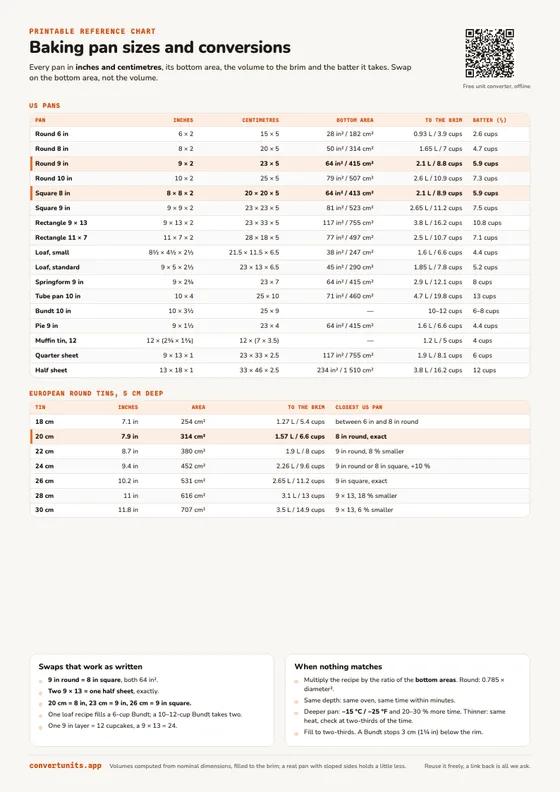
The whole chart on one page
US pans and European tins in inches and centimetres, areas and volumes, the swaps that work and the rule for the rest. One A4 sheet for the inside of the cupboard door.
Download the PDFOr carry every figure in your pocket:
US pans in inches and centimetres
Volumes are computed from the nominal dimensions, filled to the brim. A real pan with sloped sides holds a little less, which is why shop charts often say 6 cups for an 8-inch round; the ratios between pans, which are what you swap on, do not change. Batter is two-thirds of the brim, the level most cakes want.
| Pan | Inches | Centimetres | Bottom area | To the brim | Batter (⅔) |
|---|---|---|---|---|---|
| Round 6 in | 6 × 2 | 15 × 5 | 28 in² / 182 cm² | 0.93 L / 3.9 cups | 2.6 cups |
| Round 8 in | 8 × 2 | 20 × 5 | 50 in² / 314 cm² | 1.65 L / 7 cups | 4.7 cups |
| Round 9 in | 9 × 2 | 23 × 5 | 64 in² / 415 cm² | 2.1 L / 8.8 cups | 5.9 cups |
| Round 10 in | 10 × 2 | 25 × 5 | 79 in² / 507 cm² | 2.6 L / 10.9 cups | 7.3 cups |
| Square 8 in | 8 × 8 × 2 | 20 × 20 × 5 | 64 in² / 413 cm² | 2.1 L / 8.9 cups | 5.9 cups |
| Square 9 in | 9 × 9 × 2 | 23 × 23 × 5 | 81 in² / 523 cm² | 2.65 L / 11.2 cups | 7.5 cups |
| Rectangle 9 × 13 | 9 × 13 × 2 | 23 × 33 × 5 | 117 in² / 755 cm² | 3.8 L / 16.2 cups | 10.8 cups |
| Rectangle 11 × 7 | 11 × 7 × 2 | 28 × 18 × 5 | 77 in² / 497 cm² | 2.5 L / 10.7 cups | 7.1 cups |
| Loaf, small | 8½ × 4½ × 2½ | 21.5 × 11.5 × 6.5 | 38 in² / 247 cm² | 1.6 L / 6.6 cups | 4.4 cups |
| Loaf, standard | 9 × 5 × 2½ | 23 × 13 × 6.5 | 45 in² / 290 cm² | 1.85 L / 7.8 cups | 5.2 cups |
| Springform 9 in | 9 × 2¾ | 23 × 7 | 64 in² / 415 cm² | 2.9 L / 12.1 cups | 8 cups |
| Tube pan 10 in | 10 × 4, 3 in core | 25 × 10 | 71 in² / 460 cm² | 4.7 L / 19.8 cups | 13 cups |
| Bundt 10 in | 10 × 3½ | 25 × 9 | varies with the mould | 10 to 12 cups (maker’s figure) | 6 to 8 cups |
| Pie 9 in | 9 × 1½ | 23 × 4 | 64 in² / 415 cm² | 1.6 L / 6.6 cups | 4.4 cups |
| Muffin tin, 12 | 12 × (2¾ × 1⅜) | 12 × (7 × 3.5) | 12 wells | 1.2 L / 5 cups | 4 cups, ⅓ cup each |
| Quarter sheet | 9 × 13 × 1 | 23 × 33 × 2.5 | 117 in² / 755 cm² | 1.9 L / 8.1 cups | 6 cups |
| Half sheet | 13 × 18 × 1 | 33 × 46 × 2.5 | 234 in² / 1 510 cm² | 3.8 L / 16.2 cups | 12 cups |
The Bundt is the one pan you cannot compute: the fluted mould changes the volume, so use the capacity stamped on it, and bake with far less than that. King Arthur Baking’s Bundt guide measures a typical 10-cup Bundt at about 6 cups of actual baking capacity, filled to 1¼ inch below the rim.
European round tins, 18 to 30 cm
Metric recipes name the diameter of a round tin, usually 5 cm deep. The closest US pan is by bottom area, and the percentage tells you how much taller or thinner the cake will come out.
| Tin | Inches | Bottom area | To the brim (5 cm deep) | Closest US pan |
|---|---|---|---|---|
| 18 cm | 7.1 in | 254 cm² / 39 in² | 1.27 L / 5.4 cups | between a 6 in and an 8 in round |
| 20 cm | 7.9 in | 314 cm² / 49 in² | 1.57 L / 6.6 cups | 8 in round, exact |
| 22 cm | 8.7 in | 380 cm² / 59 in² | 1.9 L / 8 cups | 9 in round, 8 % smaller |
| 24 cm | 9.4 in | 452 cm² / 70 in² | 2.26 L / 9.6 cups | 9 in round or 8 in square, 10 % bigger |
| 26 cm | 10.2 in | 531 cm² / 82 in² | 2.65 L / 11.2 cups | 9 in square, exact; 10 in round, 5 % bigger |
| 28 cm | 11 in | 616 cm² / 95 in² | 3.1 L / 13 cups | 9 × 13, 18 % smaller |
| 30 cm | 11.8 in | 707 cm² / 110 in² | 3.5 L / 14.9 cups | 9 × 13, 6 % smaller |
Feel free to reuse these charts or the PDF on your own site or in your documentation; a link back to this page is all we ask.
The swaps that work without changing anything
Same bottom area within about 10 %, same depth: the recipe, the temperature and the time stay as written.
- 9-inch round = 8-inch square. Both 64 in². The one substitution everybody should know, and the one King Arthur Baking calls the simplest.
- 10-inch round = 11 × 7 = 9-inch square. 79, 77 and 81 in².
- Two 9 × 13 = one half sheet. 234 in² exactly, which is why a doubled brownie recipe bakes so well on a half sheet, and why the phyllo sheets of a baklava lie two per layer without cutting.
- 9 × 13 = two 9-inch rounds. 117 against 127 in², the layers come out 8 % thinner. Two 8-inch rounds (101 in²) give layers 15 % taller and need a few extra minutes.
- 20 cm = 8-inch, 23 cm = 9-inch, 26 cm = 9-inch square. The three metric tins that match a US pan exactly.
- 9 × 5 loaf and 8½ × 4½ loaf are not the same: the small one holds 15 % less. A 9 × 5 recipe in the small pan rises over the edge; bake the extra as two muffins.
- One loaf recipe fills a 6-cup Bundt. A 10 to 12-cup Bundt takes two. A single 9 × 5 recipe in a big Bundt gives a flat ring.
- One 9-inch layer = 12 standard cupcakes. A 9 × 13 = 24. A third of a cup of batter per well, 18 to 20 minutes instead of 30.
- 9-inch pie = 24 cm tart tin. 64 against 70 in², the filling is 10 % thinner and sets a little faster.
The rule when nothing matches: compare the bottoms
Multiply the recipe by the ratio of the two bottom areas. Round pans: area = 0.785 × diameter². Rectangles: length × width. Work in one unit, the ratio is the same in both.
An 8-inch round recipe (50 in²) into a 9 × 13 (117 in²): 117 ÷ 50 = 2.3, so make the recipe two and a quarter times, or accept a thin sheet that bakes in two-thirds of the time. A 24 cm tin recipe (452 cm²) into a 20 cm tin (314 cm²): 314 ÷ 452 = 0.7, use 70 % of everything and bake the rest as muffins.
At the same depth, the temperature does not change and the time moves by a few minutes at most. A bigger pan with the same batter means a thinner cake: check it 5 to 10 minutes early.
When the depth changes
Depth is the one thing area cannot fix, and it is what goes wrong when a sheet cake recipe goes into a loaf pan or a Bundt.
- Deeper pan (loaf, Bundt, tube, a 9 × 13 recipe in two 8-inch rounds): lower the oven by 15 °C (25 °F) and expect 20 to 30 % more time. The outside sets before the middle otherwise. Test with a skewer at the original time and keep going.
- Thinner layer (sheet pan, a round recipe spread in a 9 × 13): same temperature, 20 to 30 % less time, start checking at two-thirds of the original time.
- Fan oven: 20 °C lower than the recipe’s conventional temperature, whatever the pan. The full table is in the oven temperature chart.
- Dark metal and glass run hotter at the edges: 10 °C (25 °F) lower for glass, and check early for dark non-stick.
How full
Two-thirds is the level for most cakes and quick breads, which is what the batter column gives. Cheesecakes and dense batters can go to three-quarters, they barely rise. Muffins take a third of a cup per standard well. A Bundt stops 1¼ inch (3 cm) below the rim, or the batter spills over the centre tube and glues the pan shut. If you are not sure, measure the pan once with water and a measuring jug, then write the litres on a strip of tape under the pan.
Fast answers
- 9 × 13 in cm: 23 × 33 cm. The pan called “a 30 × 20” in Europe is 12 × 8 in, 10 % smaller.
- 8-inch round in cm: 20 cm. 9-inch: 23 cm. 10-inch: 25 cm.
- 24 cm in inches: 9.4 in, not 9 and not 10. 26 cm: 10.2 in. 28 cm: 11 in.
- 1 cup: 237 ml. A 10-cup Bundt: 2.4 L to the brim, about 1.4 L of batter.
- A loaf pan in litres: 9 × 5 holds 1.85 L, 8½ × 4½ holds 1.6 L.
- Half sheet in cm: 33 × 46 cm. The European “40 × 30” oven tray is 20 % smaller.
Your recipe is written for a 9-inch round pan. You only have an 8-inch square. What do you change?
Both bottoms are 64 square inches, so the batter sits at the same depth. Same recipe, same temperature, same time.
The app answers this kind of question in one tap.
The units are the easy part
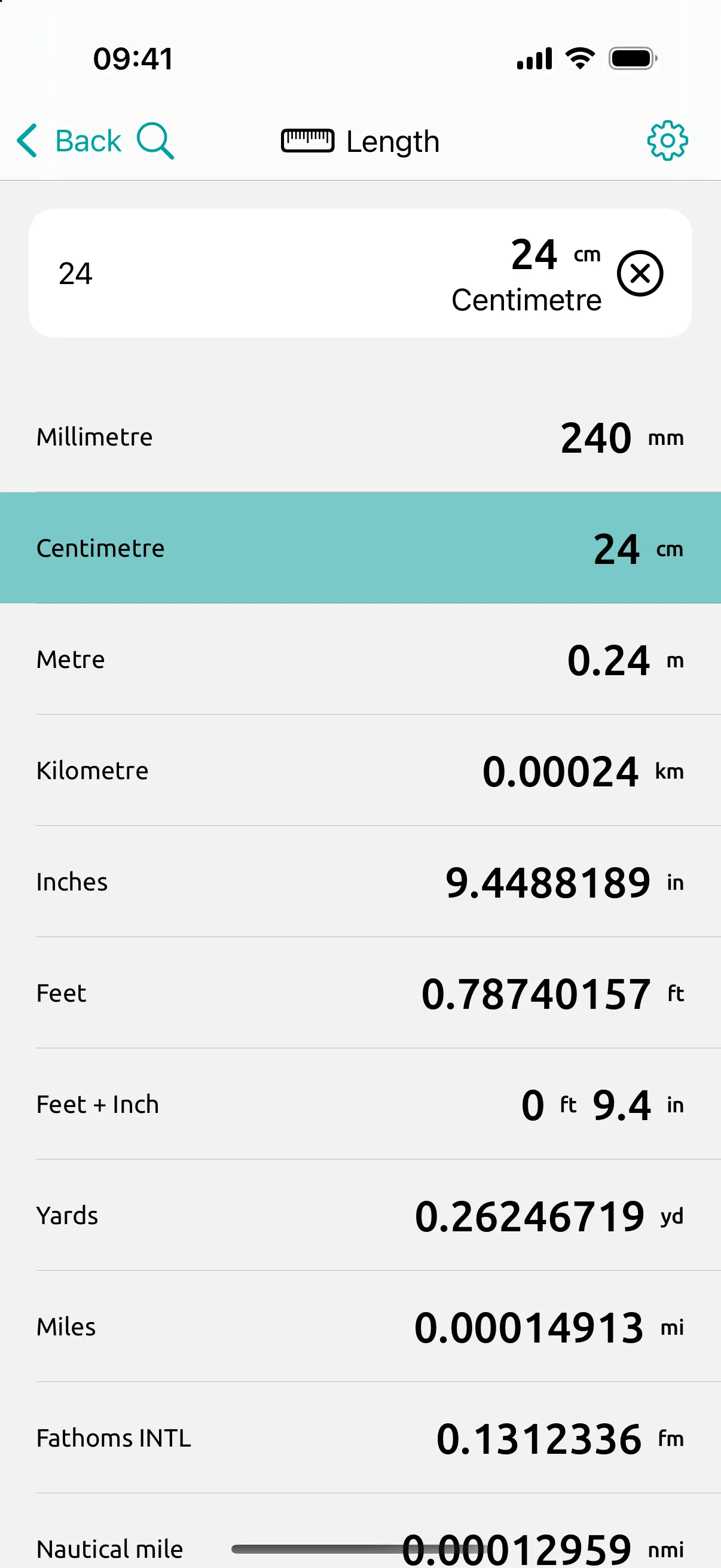
A pan chart is an inches and centimetres problem first, and a cups and millilitres one right after, and those two live in the app in your pocket. Type 24 cm into Conversion Calculator and read 9.4 in, or 2.3 L and read 9.7 cups, offline, flour on your hands, with the calculator built into the field for the 0.7 ratio. Baking is one of the everyday scenes the app was built around, next to cups to grams for every ingredient and the oven temperature chart.
Get the app free before the next recipe names a pan you do not own. And if the chart deserves the inside of the cupboard door, the PDF is here.