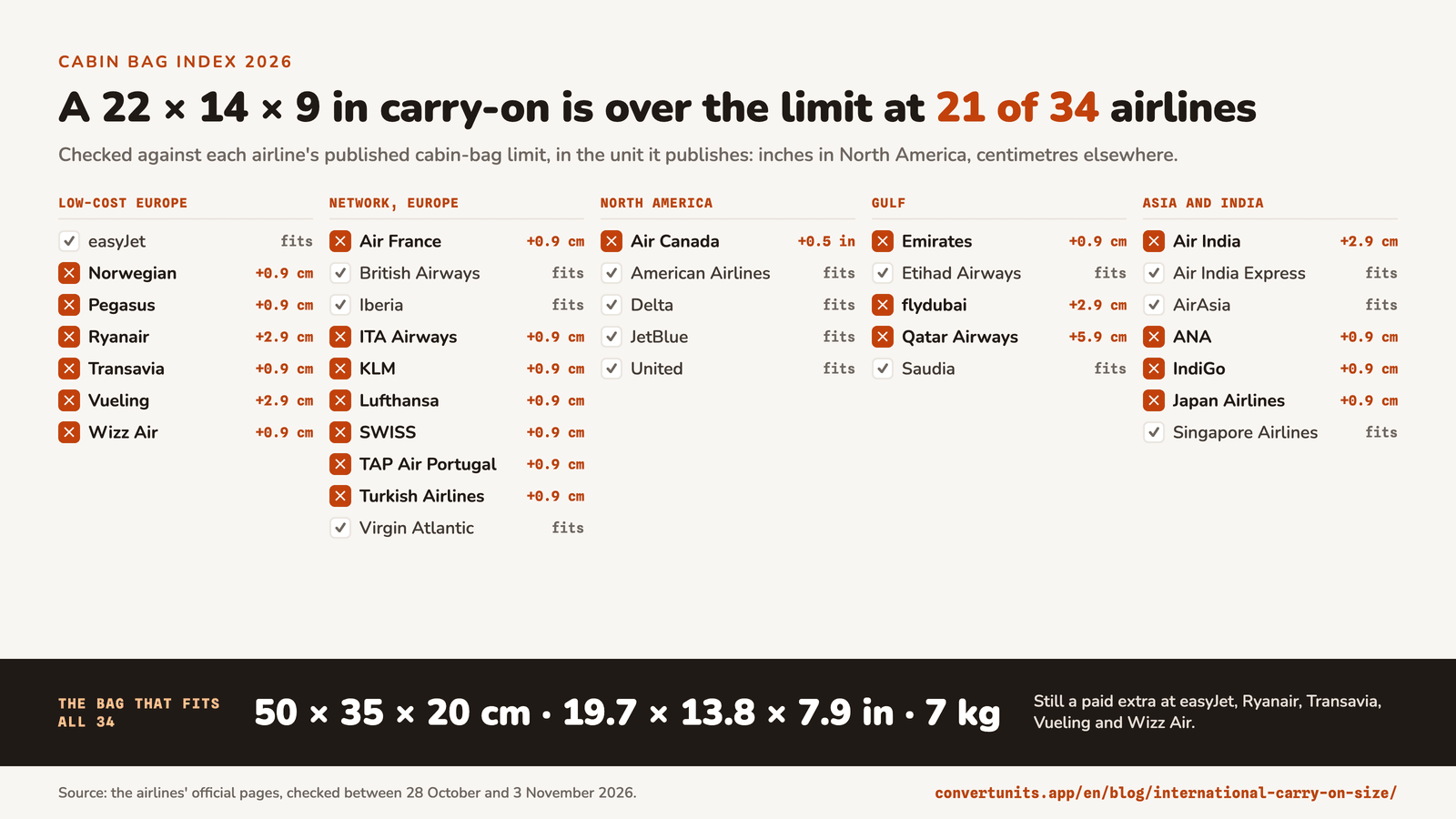
The international carry-on size that works on every airline is smaller than your domestic bag. The standard US carry-on, 22 x 14 x 9 inches, is over the published limit at 21 of the 34 airlines we compared, and at 11 of them only by its length: 22 inches is 55.88 cm, the limit is 55 cm, so the bag is 9 mm too long. The one bag all 34 accept for the overhead bin measures 19.7 × 13.8 × 7.9 inches (50 × 35 × 20 cm) and weighs up to 15.4 lb (7 kg).
This Cabin Bag Index 2026 collects the international carry-on size rules of 34 airlines in Europe, North America, the Gulf and Asia, read on their official pages between October 28 and November 3, 2026. Each limit is compared in the unit the airline publishes: inches in North America, centimeters everywhere else. The chart below is free to reuse.
Domestic vs international carry on: why the US bag runs long
American, Delta, JetBlue and United all accept a 22 x 14 x 9 bag. Outside North America, the international carry-on bag size is published in centimeters, and 19 of the 34 airlines in this panel stop at 55 cm of length. That is where a domestic bag gets caught. Nine millimeters is easy to miss at home, but the sizer at the gate is a fixed frame.
The 11 airlines where only the length is over are Norwegian, Pegasus, Transavia, Wizz Air, ITA Airways, Lufthansa, SWISS, TAP, Turkish Airlines, ANA and JAL. Air Canada is the North American exception: it publishes 21.5 × 15.5 × 9 in, so the same bag is half an inch too long there too. Qatar Airways is the strictest on length: its 50 cm limit leaves a 22-inch bag 5.9 cm (2.3 in) too long.
The US bag does fit at 13 airlines: easyJet, British Airways, Iberia, Virgin Atlantic, American, Delta, JetBlue, United, Etihad, Saudia, Air India Express, AirAsia and Singapore Airlines. Singapore publishes only the sum of the three sides, 115 cm, and the bag totals 114.3 cm. So the international carry-on size question has no single answer for a 22-inch bag: it depends on who flies the leg.
International carry-on size that fits all 34 airlines
We looked for the largest bag that all 34 accept in the cabin. It measures 19.7 × 13.8 × 7.9 in (50 × 35 × 20 cm) for 15.4 lb (7 kg), which is 105 cm (41.3 in) of total linear size and 35 liters. Each side is set by the strictest airline: the length by Qatar Airways, the width by Air France, KLM and IndiGo, the height by Ryanair, Vueling, flydubai and Air India.
If you buy one bag for trips abroad, this is the international carry-on size to shop for. It is still a paid extra at easyJet, Ryanair, Transavia, Vueling and Wizz Air, because it is larger than their free personal item.
Who charges for a carry-on: 13 of 34 airlines
Knowing the international carry-on bag size is half the question. The other half is whether your fare includes the bag at all.
At 5 European low-cost airlines, the cabin bag is a paid add-on on every basic fare: easyJet, Ryanair, Transavia, Vueling and Wizz Air. The cheapest ticket covers the personal item under the seat, nothing more.
At 8 others, it depends on the fare: Norwegian, Pegasus, Air France, KLM, Lufthansa, SWISS, Air Canada and United. Their basic economy fare includes only the personal item, and the fares above it add the carry-on. The trend is spreading: the Lufthansa Group’s Economy Basic fare, launched in May 2026, has covered all of Europe since October 27.
The other 21 include a cabin bag on every fare: British Airways, Iberia, ITA Airways, TAP, Turkish Airlines, Virgin Atlantic, American, Delta, JetBlue and every Gulf and Asian carrier in the panel. For the size and weight at each airline, line by line, see our carry-on chart for all 34 airlines.
Gate fees, from highest to lowest
This is where getting the international carry-on size wrong costs the most. A bag you did not pay for online, or one that does not fit the sizer, is charged at boarding. The gate fee, from the highest down:
| Airline | Gate fee |
|---|---|
| Lufthansa | $125 (110 €) |
| Air Canada | 78 CAD or USD |
| TAP Air Portugal | 77 € and up |
| Ryanair | 75 € or £75 |
| Vueling | 60 to 75 € |
| United | $75 |
| Transavia | 70 € and up |
Booked in advance, the same bag costs much less: at Ryanair, Priority runs 12 to 36 €, against 46 to 75 € at the gate. If you know you need the bag, buy it online. The gate price is set to make you do exactly that.
The EU law: only the personal item becomes free
Regulation (EU) 2026/2202 was signed on September 16, 2026, published in the Official Journal on October 2 and entered into force on October 22. Its baggage rules apply from October 23, 2027. Until then, nothing changes at the counter.
What it requires is a free personal item: a bag of up to 40 × 30 × 15 cm (15.7 × 11.8 × 5.9 in), or one that fits under the seat, with no weight limit. What it does not require is a free carry-on. The cabin bag for the overhead bin is accepted “subject to the capacity of the aircraft cabin”. Fares that include it must be shown by default, but fares without it remain allowed. If the cabin is full, the bag goes in the hold at no charge.
The law does not set an international carry-on size either. Each airline must have a “reasonable policy”, and a common minimum size is left to the coming revision of Regulation 1008/2008. The European Parliament wanted an included bag of 100 cm and 7 kg. It voted for it on January 21, 2026, then the measure was dropped in conciliation in June. Several outlets reported a free 7 kg carry-on. It is not in the final text, which you can read on EUR-Lex.
That 100 cm cap would have been smaller than the bag that fits everywhere today, which totals 105 cm (50 + 35 + 20).
Volume, weight, personal item: how far apart airlines are
- Cabin bag volume: from 41.8 liters at flydubai to 63 liters at British Airways, Saudia and easyJet, 1.5 times more.
- Weight: 7 kg (15.4 lb) at 10 airlines, all in the Gulf and Asia. Up to 15 kg (33 lb) at easyJet. Six publish no limit at all: British Airways, Air Canada, American, Delta, JetBlue and United.
- Personal item: from 12 liters at AirAsia and Singapore Airlines to 32.4 liters at easyJet, 2.7 times more. Emirates, Etihad, Qatar Airways, Saudia and Air India Express offer none on its own: everything has to fit in the 7 kg of the cabin bag.
The free personal item in the EU law, 40 × 30 × 15 cm, holds 18 liters. That is half of the 35-liter universal bag. For a weekend, it is a well-packed backpack; for a week, you will still pay for the carry-on.
Method and sources
- 34 airlines: 7 European low-cost, 10 European network carriers, 5 North American, 5 Gulf and 7 from Asia and India.
- Sources: only the airlines’ official pages, with the date each line was checked (October 28, 2026, and November 3 for Virgin Atlantic).
- Units: the international carry-on dimensions of each airline are compared in the unit it publishes, inches for North America, centimeters elsewhere. Converting one into the other can flip a verdict on rounding alone. Singapore Airlines publishes only the sum of the three sides, 115 cm, so it is compared on that sum.
- Calculation: a script reads our data and produces every figure and the chart. Nothing is computed by hand.
Journalists: the data, the chart and our contact details are on the press page. Free to reuse, with a link to this page.
International carry-on size: quick answers
- Is my 22 x 14 x 9 domestic carry-on OK abroad? Yes at 13 of 34 airlines. At the other 21 it is over the limit, at 11 of them by 9 mm of length.
- What international carry-on size fits every airline? 19.7 × 13.8 × 7.9 in (50 × 35 × 20 cm) and 15.4 lb (7 kg), accepted by all 34 and a paid extra at 5 low-cost airlines.
- Will my 55 × 40 × 20 cm bag fit? It is over the limit at 15 of 34 airlines, mainly because of its 40 cm width: Air France, KLM and IndiGo stop at 35 cm, North American carriers at 14 in (35.6 cm).
- Does the EU law make carry-ons free? No. It makes the 40 × 30 × 15 cm personal item free, from October 23, 2027.
To convert any limit published in inches, the cm to inches converter works it out live. And for checked luggage, the baggage allowance of the same 34 airlines follows the same method.